Uncovering the Mystery of 1991
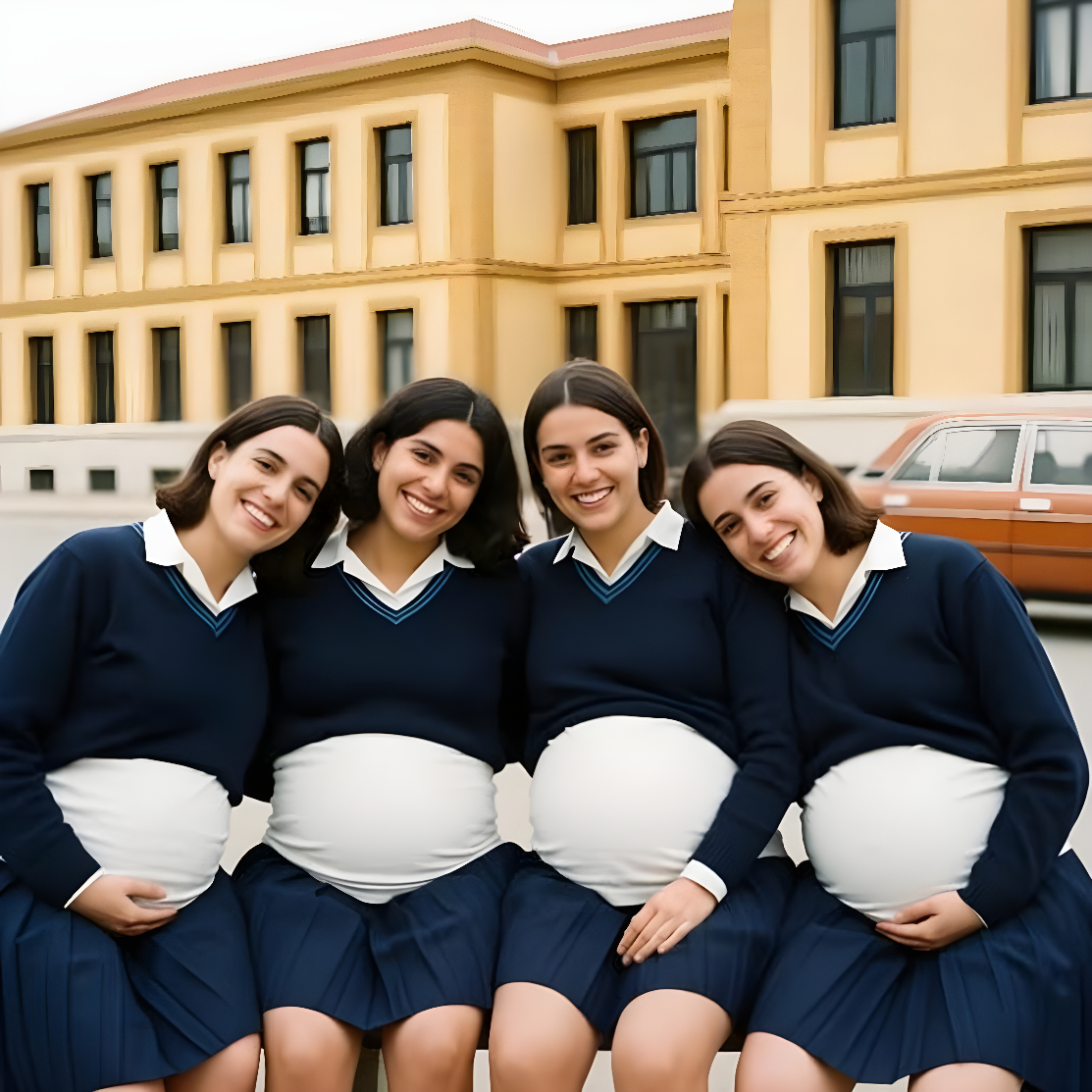
In the year 1991, a public school named Alto del Prado, located on the outskirts of Santander, resembled any other educational institution: a dull gray building, fatigued teachers, and teenagers eager to leave. Nothing hinted that this particular academic year would forever alter the community’s memory. However, within weeks, four girls from the same class—Nerea Salvatierra, Clara Busto, Marisa Ceballos, and Julia Arjona, all aged 16—were discovered to be expecting.
The news spread rapidly. Families reacted with disbelief and shame while educators refrained from commenting. Rumors abounded: claims of an agreement among the girls, a single father for all, or a prank that spiraled out of control. Nonetheless, nothing could prepare anyone for the shocking events that followed. One April morning, Nerea was absent from school. She never returned home. Two days later, Clara vanished. Subsequently, Marisa and then Julia disappeared, one after another, without farewells, notes, or signs of struggle. They simply vanished.
The Civil Guard undertook a thorough investigation: conducting interviews, searching nearby woods, performing road checks, and interrogating boyfriends, teachers, and even the girls’ parents. No leads emerged. Local media intensified the pressure, sensationalizing the case until it was shelved due to a lack of progress. The school saw a decline in students, hallways fell silent, and the town was engulfed in feelings of guilt and fear. With the passing years, the memories of the four girls transformed into a nearly taboo subject.
Fast forward thirty years to 2021; the school still stood, albeit with partial renovations. The long-time janitor, Eusebio Santín, was one of the few who had been working there since the nineties. He was reserved, meticulous, and possessed a surprisingly clear memory. One October morning, while rummaging through a storage room set for demolition, he found a loose old vent cover. Upon removing it, he discovered a narrow, deep gap behind the wall covered in dust. Inside was a damp folder wrapped in plastic from the 90s.
He brought it into the light and, upon opening it, was left speechless. The folder contained photos of the four girls, some taken inside the school and others in unidentified locations; blueprints; schedules; name lists; and, at the very end, a letter dated March 1991, with trembling handwriting signed by Julia Arjona.
Eusebio, with freezing hands and a racing pulse, realized he couldn’t keep this to himself any longer. He had hidden a secret for far too long, perhaps without even realizing it. And now, for the first time in thirty years, something was finally happening.
“I must show this to someone,” he murmured.
But first, he wanted to read the letter.
What he discovered within would forever alter the official narrative of these events.
The letter was handwritten in faded blue ink. Some words were smeared due to moisture, yet the message remained fully legible. Eusebio sat down in the hallway on a bench, seemingly needing physical support to process what he was about to learn.
“If someone finds this, please do not judge us. We had no other way out.”
Julia began her explanation, stating that neither she nor her friends had intended any of this initially. Each girl navigated her own emotional turmoil around the pregnancy: fear, shame, uncertainty. The peculiar part was that all four learned they were expecting around the same time. None had stable relationships. None wanted to reveal the identity of their child’s father. Yet, they all had something in common: they had trusted the same individual.
That name was emphasized in the letter and repeatedly appeared in the notes found in the folder: Alfonso Mera, a temporary History teacher, only hired for that school year and described by students as “charming,” “young,” and “excessively friendly.”
According to Julia, Mera had manipulated them, each in her own way. With Nerea, he posed as a confidant; with Clara, a protector against bullying; with Marisa, a scholarly advisor; and with Julia, someone who understood her complicated family situation. In essence, he was a predator concealing himself under the guise of caring for his students.
The letter recounted how, upon starting to suspect that he might have abused multiple girls, they confronted him. Mera responded coldly, convincing them that no one would support them, that he had connections, that he could deny everything, branding them as “lying adolescents trying to ruin his life.” He then proposed a “solution”: temporarily relocating to a countryside house that he claimed belonged to his family, where they could “spend the pregnancy in peace.”
Julia admitted that, at that moment, their judgment was clouded. None wanted to confront their parents. None wished to become newspaper headlines. And all felt paralyzed by fear. Thus, they agreed.
On March 14, 1991, after classes, Mera drove them in pairs to an abandoned farmhouse near the Picos de Europa. Julia described it as a refuge at first. However, they soon realized it was not a hiding place, but a trap. The doors locked from the outside, they had no phone, and Mera returned every few days to drop off supplies, repeating that “everything would be fine if they stayed silent.”
The letter ended abruptly:
“If this ends badly, let it be known that the truth must come out. We did not leave by choice. We were taken. And we are not the only ones.”
Eusebio felt a chill. Not just from the revelations within the letter, but from a recurring phrase that appeared on several of the papers in the folder: “Search in the old pavilion — testimonies — classroom 3B.”
At that moment, he realized there was more at play, much more.
Eusebio opted not to contact the police immediately. He wanted to verify, even if partially, the findings he had discovered. The “old pavilion” still stood, albeit closed for years due to moisture issues. No one entered there. No one except him, who had keys to every door.
Once inside, he headed to classroom 3B. Dust blanketed the desks, and frayed cables dangled from the ceiling. To one side, he spotted a rusted filing cabinet. Pulling it open revealed an identical folder to the first, though in better condition. Inside were loose leaflets containing handwritten statements from other students, all dated between January and March of 1991.
There lay the missing piece: other students had also suspected Alfonso Mera. Some claimed to have seen him enter the AV room with different girls. Others noted that he altered and rewrote tutoring schedules without notifying anyone. One student recounted how he had asked her overly personal questions and touched her awkwardly on the arm. There even existed a sketch of Mera’s license plate.
The most alarming item was a report prepared by the school counselor, dated two weeks prior to the girls’ disappearances, which recommended formally investigating teacher Mera for “improper conduct.” Someone had scrawled in red ink at the margin: “DO NOT MOVE — Order from the principal.”
Eusebio closed his eyes. He vividly remembered that principal: a stringent man, connected politically, obsessed with avoiding scandals. He had passed away more than ten years ago.
All the puzzle pieces were starting to align.
But the essential question remained: What had happened to the girls?
Eusebio accessed the rural property registry for Cantabria. After hours of searching, he discovered that Alfonso Mera had inherited a small house in a remote area of Liébana. This location matched the description from the letter.
He went there.
The farmhouse was dilapidated due to time. The main door yielded easily. Inside, he found remains of old mattresses, cans of food, and water bottles dated 1991. In a corner, partially hidden beneath some boards, lay a child’s notebook with four names inscribed on the cover: Nerea, Clara, Marisa, Julia.
The content was devastating. Brief notes exchanged among the girls:
- “Today he didn’t come. There’s no milk.”
- “I heard a car, but it wasn’t him.”
- “My tummy hurts.”
- “We must get out.”
The last page was written hastily:
“We’re going to try it tonight. We cannot stay here. If he finds us, you know what happens.”
It remained uncertain if they succeeded. There were no remains, no signs of struggle, no new clues. However, now there existed sufficient documents to reopen the case, prove manipulation, and expose the web of silence that had concealed it.
Eusebio handed everything over to the authorities. Subsequent investigations revealed that Mera had fled Spain in 1992 and was living under a different identity in Portugal, where he was eventually apprehended. He never confessed what happened that night in the rural house.
Yet, thanks to the janitor, the silence was finally broken.
And the town of Santander, thirty years later, could start to mention their names once more.
Nerea. Clara. Marisa. Julia.
Four stories that were finally freed from obscurity.