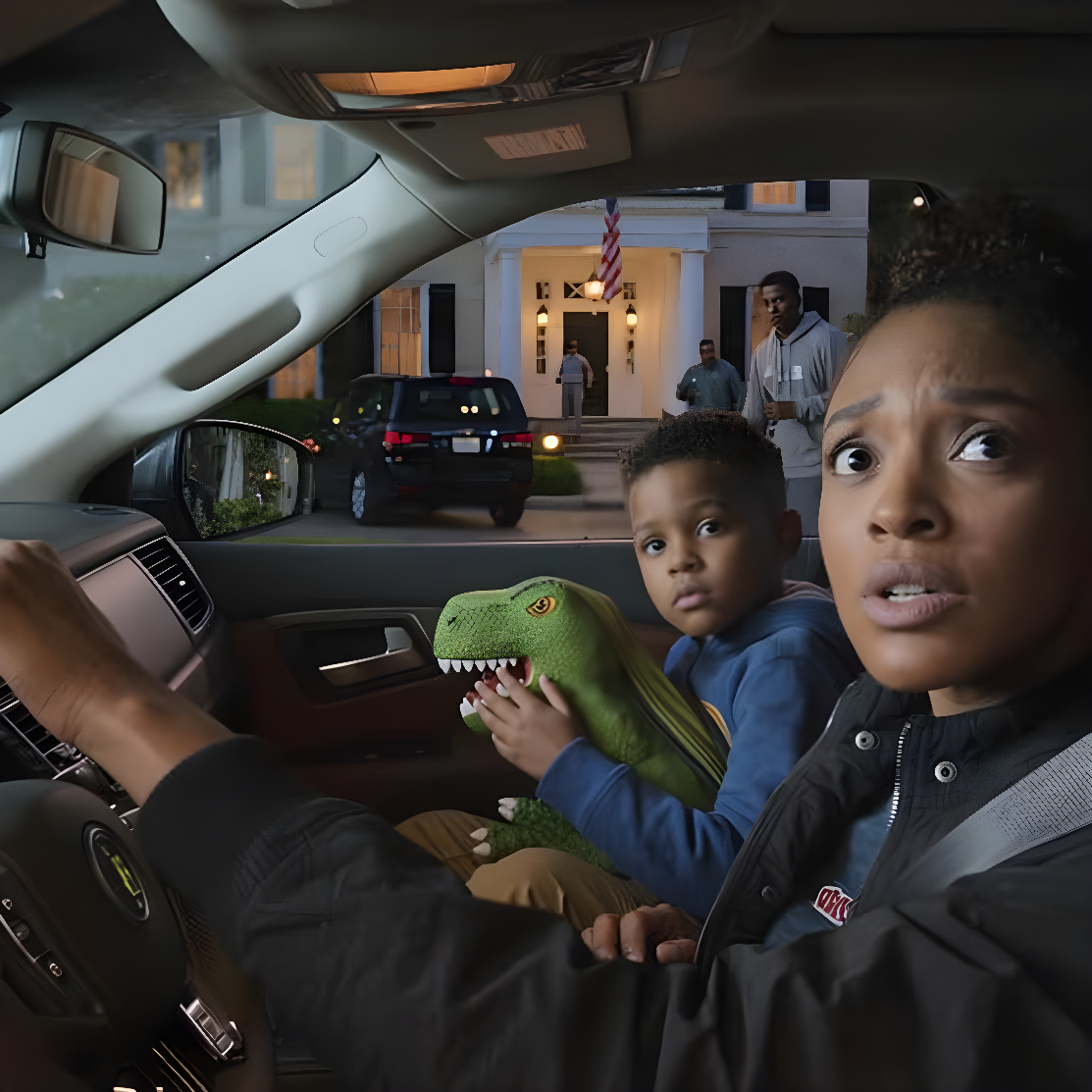
My six-year-old son whispered, “Mom, this morning I overheard Dad saying he’s preparing to do something harmful to us.” So I took him and fled our tranquil suburban home. However, when I secretly returned to grab a few essentials and his beloved teddy bear, the sight before the garage door left me utterly paralyzed.
I had just dropped my husband off at the airport, thinking it was simply a routine business trip. Yet, right before my departure, my young son tightened his grip on my hand and whispered, “Mama, don’t go back home. This morning, I overheard Daddy planning something very bad for us. Please trust me this time.”
Believing him, we found a place to hide, and what awaited me next sent me into a state of panic.
But before we move on, please remember to share where you are viewing this from in the comments. We enjoy seeing how far our narratives reach.
That Thursday night, the fluorescent lights of Hartsfield–Jackson Atlanta International Airport felt painfully bright. I was exhausted, not just from lack of sleep but an all-encompassing fatigue I had carried for months without comprehending its source.
Next to me stood my husband, Quasi, displaying that perfect smile he reserved for social settings. Dressed in a sharp gray suit, briefcase in tow, the scent of the premium cologne I had gifted him for his recent birthday lingered in the air. To everyone in that terminal, we epitomized Black excellence, a power couple. He was the high-flying executive while I, the devoted wife, saw him off before his major business engagement in Chicago.
If only they knew the truth.
By my side was my little boy, Kenzo, at just six years old, holding my hand firmly with a sweaty grip. He was my whole world. However, that night he stood unusually still and quieter than usual. Keep in mind, Kenzo had always been a child who observed more than he engaged. Still, something in his eyes flickered with a fear I couldn’t identify.
“This meeting in Chicago is critical, babe,” Quasi mentioned, drawing me in for a calculated embrace. Everything about him was so meticulously calculated; I had just been oblivious to it. “Three days at the most, and I’ll be back. You’re going to hold down the fort here, right?”
- Hold down the fort. As if my existence revolved solely around managing everything while he built his empire.
But I managed a smile, adhering to the expectation. “Of course. We’ll be just fine,” I replied, feeling Kenzo’s grip on my hand tighten even more.
Quasi crouched down to our son’s level. He placed his hands on Kenzo’s shoulders like a perfect father would. “And you, little man, take care of Mama for me, okay?”
Kenzo’s silence spoke volumes as he merely nodded, his eyes locked onto his father’s face. That particular gaze seemed to be committing every feature to memory, as if he were saying goodbye for good.
I should have sensed something was amiss at that moment. I should have picked up on the signs. But when they come from those we love, it’s as if we wear blinders. After eight years of marriage, we blink away the possibility of surprises.
How naïve of me.
Quasi pressed a kiss to Kenzo’s forehead and then mine. “Love you both. I’ll see you soon.” And with that, he turned, grasped his carry-on, and walked toward the TSA checkpoint.
Kenzo and I stood frozen amidst the hubbub of goodbyes and reunions, our eyes following him until he vanished from sight. With a deep breath, I finally uttered the words. “Come on, baby. It’s time to go home.”
My voice emerged weary. All I desired was to retreat to our Buckhead residence, shed the uncomfortable heels I wore to fit a certain image, and perhaps watch something lighthearted on TV until sleep reclaimed me.
We began our walk down the elongated airport concourse, our footsteps echoing against the polished floors. Now quieter than ever, Kenzo seemed burdened, and I could sense the tension radiating from his small form through our connected hands.
“Everything alright, sweetheart? You’re awfully quiet today.”
His response didn’t come immediately. We continued walking, passing closed shops, flig…ht monitors, and hurried travelers pulling rolling suitcases. When we approached the exit, nearing the automatic glass doors, Kenzo suddenly came to an abrupt halt.
His sudden stop nearly made me trip. “Kenzo, what’s the matter?”
That’s when he met my gaze, and I will forever remember the expression on his face—a sheer, unadulterated terror that no six-year-old should ever know.
“Mama,” he whispered, his voice shaking, “we can’t go back home.”
Something strange occurred inside my chest. I crouched to be eye-to-eye with him, clutching his little arms. “What do you mean, sweetness? Of course, we’re heading home. It’s late, and you need sleep, don’t you?”
His voice rose, filled with urgency. Heads turned in curiosity toward us. He swallowed hard before continuing in a frantic whisper. “Mama, please, we can’t do this. You’ve got to believe me this time.”
This time. Those two words struck me because they were indeed heartfelt truths. Some weeks passed when Kenzo alerted me about a peculiar car stationed outside our house. That same car appeared for three consecutive nights. I dismissed it as a fleeting coincidence. Days later, he assured me he heard Daddy murmuring in the home office about resolving “the problem” for good. I brushed it off as mere business chatter and urged him to disregard adult conversations. I didn’t believe the validity of his words.
And now, here he was pleading with me, tears starting to shimmer in those deep brown eyes.
This time, I vowed to believe him. “Tell me what’s going on, Kenzo.”
My tone steadied despite the inner chaos.
He glanced around, seemingly anxious about being overheard. Pulling my arm, he leaned closer, whispering in my ear. “This morning, very early, I woke before everyone else. I went to get water and heard Daddy in his office. He was on the phone. Mama, he said that tonight while we’re asleep, something awful would happen. That he’d have to be far away when it happened. That we… that we wouldn’t be in his way anymore.”
My blood turned ice cold.
“Kenzo, are you certain? Are you positive about what you heard?”
He nodded fervently.
“He mentioned some people coming to handle things. He said he’d finally be free. Mama, his voice… it wasn’t the Daddy I know. It sounded different. It was frightening.”
Initially, I wanted to reject it all, to label it as mere youthful imagination, that he had misheard, that Quasi would never—
But I recalled details, little things I had chosen to overlook. Three months prior, Quasi had increased his life insurance policy, insisting it was merely a precaution for our family’s financial future. He recommended that I put everything—the house in Buckhead, the car, our joint savings—solely in his name.
- “It simplifies tax matters, love.”
He had displayed anger when I mentioned wanting to resume my work. “We don’t need that, Ayira. I manage everything.”
The strange calls he routinely received while locked in his office, the mounting business trips, and that conversation I unintentionally overheard a fortnight ago when I believed he was asleep. He was murmuring into the phone: “Yeah, I acknowledge the risks, but no other options exist. It must appear accidental.”
I had convinced myself it pertained to work, an outlandish investment ploy.
But what if it wasn’t?
I peered at Kenzo, noting that terrified countenance, the tears cascading, the trembling hands, and I made what became the most significant choice of my life.
“Alright then, son. I believe you.”
Relief washed over his face immediately, but it was fleeting.
“So… what do we do?”
Good question. My mind raced. If Kenzo’s fears held truth—and my instincts were propelling me to accept them—returning home was equivalent to sealing our fate. But where would we go? To whose home? Every friend we had belonged to Quasi as well, entrenched in the same social circle. My family resided in North Carolina. And if I miscalculated, thinking it was all a disastrous misunderstanding…
But what if it wasn’t?
“Let’s head to the car,” I decided. “But we won’t be going into the house. We’ll maintain our distance and observe, just to ensure. Okay?”
Kenzo nodded affirmatively.
I reclaimed his hand, and we trudged to the parking structure. My heart pounded in my chest, every pulse a reminder of the peril we were in. Each move felt laden with weight. The cool night air hit me as we stepped outside. The parking deck was dimly lit, dotted with a few cars. Ours sat in the corner, a silver SUV Quasi insisted we purchase last year.
- “A secure vehicle for my family,” he insisted.
Safe? What a bitter joke.
We climbed in. I buckled Kenzo before securing myself. My hands trembled so badly that I failed to start the engine on my first three attempts.
“Mama.” Kenzo’s voice emerged quiet from the back seat.
“Yes, sweetheart?”
“Thank you for trusting me.”
I caught my reflection in the rearview mirror. He curled in his seat, clutching the dinosaur backpack he took everywhere.
“I will always believe you, darling. Always.”
And in that heartbeat, I realized I should have voiced that sooner. I should have listened from the outset.
Quietness filled the car as I maneuvered through the streets. Instead of heading straight to our driveway, I opted for a circuitous route through the neighborhood, discovering a spot on a parallel street that provided a concealed view of our home behind the trees without us being spotted easily. I parked beneath the shadows of two large oaks. From that vantage point, we could see our house.
Everything appeared mundane. The streetlights illuminated the sidewalk, our well-kept lawn, the porch where Quasi and I shared coffee on Sundays, the window of Kenzo’s room adorned with the superhero curtains he had chosen.
Home. Or so I thought.
I powered off the engine and lights. Total darkness enveloped us, with silence descending over the cabin except for our breathing.
“And now, we wait,” I whispered.
Kenzo remained quiet, his gaze fixated on the house. Thus we waited, unaware that in less than an hour, everything I believed about my life was set to crumble.
The dashboard clock read 10:17 p.m. and doubts flooded my mind. Here I was, hiding on a desolate street with my six-year-old, surveilling my own house as if we were living through a terrible film. What kind of mother had I become? What sort of wife was I who suspected her own husband of… what exactly? I couldn’t fathom the truth.
Quasi had never been physically abusive, nor had he raised his voice at Kenzo. He was a devoted father, a provider. Yet, was he genuinely a loving husband?
A question struck deeply and blindsided me. When was the last time Quasi looked at me with sincere affection? When had he inquired about my day, genuinely wanting to know the answer? When did he touch me without it feeling prearranged, mechanical? When did I last feel cherished instead of merely… maintained?
“Mama, look.”
Kenzo’s voice jolted me from my introspections. My heart raced.
“What? What do you see?”
“That car.”
I followed the direction of his pointer. A vehicle turned onto our street, though it wasn’t just any vehicle. It was a dark van. No decals or visible front plate. The windows were so darkly tinted that it was impossible to identify anyone inside. The van slowed as it passed the houses—too sluggish for it to be just a passing vehicle. It felt predatory.
As it stopped right before our house, I felt my breath hitch in my throat.
“It can’t be,” I murmured. “It just can’t.”
But it was.
Both front doors swung open. Two men exited. Even from that distance, and despite the poor lighting, it was clear they were not ordinary technicians or delivery personnel. Dressed in dark clothing, their hoods covering their heads, they moved with surprising stealth and purpose. They lingered momentarily in front of our driveway gate, scanning the surroundings.
My instinct urged me to scream, to call the authorities—to do something—but I felt paralyzed, as though ensnared in a nightmare from which I could not awaken.
The taller man reached into his pocket. I anticipated he would produce a crowbar or some tool to force entry—a standard burglary. I could deal with that. Call the police, file a report, and move on.
But what he revealed sent my world crashing down.
A key.
He had a key to our house.
“Mama…” Kenzo’s voice quivered. “How do they have a key?”
My mind raced, yet I struggled to form an answer. I was in the midst of combatting nausea.
The man unlocked the front door as though he belonged there. No forced entry, no breaking—it was simply unlocked. Only three individuals possessed a key to our residence: myself, Quasi, and the spare key secured in his home office within the locked drawer.
The two men crossed the threshold into my sanctuary—the place where I slept last night, where I prepared grits and eggs for Kenzo in the morning, where I felt shielded. No lights were turned on. I saw beams of flashlight flickering behind the curtains. They were searching for something.
Or even worse, preparing something.
Time lost meaning as I sat there, paralyzed, watching the scene unfold. It could have been five minutes or fifty. All that existed was that horrific image: two strangers inside my home, armed with keys only my husband could have provided.
Suddenly, I caught a whiff of something. Initially, I thought I was imagining it, but the scent intensified. A chemical stench, pungent. Gasoline.
“Mama, what’s that smell?” Kenzo inquired.
That’s when I detected smoke. It began as a thin line escaping from the living room window, then another from the kitchen window. The ominous orange glow flickered in the air, signifying one inevitable outcome.
Fire.
“No.”
Acting on instinct, I bolted from the vehicle.
“No. No. No.”
Kenzo pulled me back. “Mama, no. You can’t go there.”
He was right. I knew it. But it was my home. My belongings. The treasured photographs of Kenzo’s infancy. My wedding attire neatly stored in the closet. The imaginative drawings Kenzo created and proudly displayed on the refrigerator. The quilt stitched together by my late grandmother.
- All engulfed in flames.
The flames propagated swiftly—terrifyingly so. Mere minutes transformed the living room into a blazing inferno. The fire licked the walls, shattered the windows, and climbed to the second floor where Kenzo’s room was located.
Then the sirens erupted. Someone must have spotted the smoke and contacted the fire department. The dark van rolled away, lights off, vanishing around the corner mere seconds before the first fire truck arrived.
Tremors wracked my body as I stood there, barely able to remain upright. Kenzo held me from behind, burying his little face in my back, sobbing.
“Kenzo was right,” I whispered. “You were right, sweetheart. Had we returned home, had I doubted you, we would have been inside there, asleep and blissfully ignorant. And those men would have… would have…”
The thought was too horrendous to articulate. My legs gave way, and I sank to my knees in the dark street, watching my world become a smoldering heap of ashes.
My phone vibrated within my pocket. With trembling hands, I retrieved it. It was a message from Quasi.
“Hey babe, just landed. Hope you and Kenzo are resting well. Love you both. See you soon.”
I read the message again and again. Each word pierced me like a blade. Every heart emoji felt toxic. He was aware. Of course, he was aware. He was in another state constructing the perfect alibi while orchestrating our demise—explicitly crafting a scenario to eliminate us. Then he planned to return as a heartbroken husband and mourning dad, shedding tears at the funeral, receiving condolences, and claiming everything—the life insurance, our property, the bank accounts.
That’s what Kenzo overheard him discussing on the phone.
“I’m finally going to be free.”
Free of me. Free of his son.
Pain surged within my stomach. I turned away and vomited onto the curb, expelling everything from my system, alongside the last remnants of deception I held about my marriage.
After I finished retching, I wiped my mouth on my sleeve and faced Kenzo. He was seated on the curb, knees drawn to his chest, watching the house engulfed in flames. Tears streamed down his face, though he had stopped sobbing. He just stared quietly. A six-year-old shouldn’t harbor that expression—an unsettling understanding that people who should shower you with love could inflict harm.
I enveloped him in a tight embrace.
“I’m sorry,” I murmured into his hair. “I’m so sorry for not heeding your words sooner. I regret everything.”
He clung to me, as if I were the only solid reality left in this topsy-turvy world.
And perhaps I was.
“What will we do now, Mama?”
That was the million-dollar inquiry, wasn’t it? What do you do when you realize that the individual who vowed to cherish and safeguard you wants you dead? Returning home was not an option. Our home no longer existed. Reporting to the police wasn’t feasible at this juncture. Quasi had an ironclad alibi, leaving only me and a six-year-old’s word against his.
We couldn’t reach out to friends or family. They would label me as crazy, merely suffering shock from the fire, concocting stories. And Quasi… he remained free, airborne at that moment, surely rehearsing the expressions of shock and sadness he would display upon “discovering” the tragedy.
We required assistance. Help from someone unknown to Quasi—someone who understood. Someone adept at dealing with… with what? Murder attempts? Schemes? Insurance fraud? All of it.
Then I recalled my father.
Grandpa Langston, before his passing two years ago, gifted me a card. It was on a particularly tough day following his cancer diagnosis. He requested my presence in his hospital room, grasped my hand, and said, “Ayira, I don’t trust your husband. I never have. If you ever need help—real help—seek out this person.”
The card bore a name, “Zunara Okafor, Attorney at Law,” along with a phone number.
Initially, I was offended. How could my father distrust Quasi? The man who had been so attentive, visiting him in the hospital and covering medical expenses for premier doctors.
Yet now… now his instincts resonated. My father perceived something I was too in love to acknowledge, and he left me a vital lifeline.
I once again grabbed my phone. Battery at 23%. Decisions had to be made swiftly.
“Kenzo, remember that card Grandpa gave me? The one I kept in my wallet?”
He nodded solemnly.
“I’m going to contact that person. She will assist us.”
At least, I hoped for that.
With unsteady fingers, I dialed the number. Three rings. Four. Just as it was about to go to voicemail, a female voice, raspy yet assertive, answered. “Hello, this is Attorney Okafor.”
“Attorney… Miss Okafor, I’m Ayira. Ayira Vance. You don’t know me, but my father—my father was Langston Vance. He gave me your number. I… I need help. Urgently.”
A pause followed.
“Ayira. Langston spoke of you. Where are you?”
“My house just burned down. I am on the street with my son, and my husband… my husband tried to kill us.”
Another extended pause. When she spoke again, her tone was changed, more insistent. “Are you safe right now? Can you drive?”
“Yes.”
“Then jot down this address.”
Attorney Zunara’s office was situated in a centuries-old brick structure in the Sweet Auburn district. The kind of place you pass without noticing. Lackluster sign, merely a small peeling plaque reading: “Okafor Legal Counsel.”
It was nearly midnight when I parked outside. The street was eerily quiet, with a couple of streetlights flickering. Kenzo had nodded off in the backseat during the drive, exhausted from crying. I carefully carried him inside.
Before I could ring the doorbell, it opened. A woman awaited me. She appeared around sixty, gray locs pulled back in a bun, reading glasses hanging from a chain. Dressed in casual jeans and a simple shirt, she appeared as though she had just been roused, yet her eyes were alert, assessing every detail of me and Kenzo.
“Ayira, right? Come in quickly.”
I stepped in, and she secured the door with three different deadbolts. The office was permeated with an aroma of old books and strong coffee. Stacks of files were piled on surfaces, old cabinets stood by, and a table overflowed with papers.
“Lay the boy on that sofa,” she instructed. “There’s a blanket on the chair.”
I gently laid Kenzo down, ensuring he remained covered. He continued sleeping, his face still marred with streaks of tears.
“Coffee?” she offered.
I was inclined to decline, but she was already pouring two cups. Handing one to me, she pointed toward the chair in front of her desk. “Sit down and provide me with the complete story from the start. Provide every detail.”
And I recounted everything. I narrated Quasi’s trip, Kenzo’s whispered warning at the airport, our decision to hide and observe, the men armed with keys, and the inferno that ensued. Quasi’s text feigning concern while knowing we should have perished.
Throughout my tale, Attorney Zunara listened intently. Her fingers entwined under her chin, her gaze fixed on me. Once I concluded, she remained silent for a moment.
“Your father requested I look out for you should something like this occur,” she finally remarked. “Langston was an astute man. He discerned details about your husband that you were keen to overlook.”
That stung, yet it was true.
“He suspected Quasi wasn’t who he presented himself to be. That he married you for access. He believed he was hazardous.”
She took a sip of her coffee.
“Langston left behind some items—documents, information about you and Quasi. I had hoped to never utilize them, but…”
She headed to a locked cabinet and returned with a hefty folder, placing it before me on the desk.
“Three years ago, your father discreetly hired a private investigator to scrutinize Quasi’s business dealings.”
My heart sank.
“What were the findings?”
“Debts. A multitude of gambling debts, primarily. Your husband has a serious issue, Ayira. He owes money to loan sharks and underground establishments—dangerous individuals.”
She began flipping through the folder, displaying bank statements, photographs, and reports.
“His businesses have been bankrupt for two years. He has been utilizing the funds from your mother’s inheritance to patch the holes, and that’s nearly gone.”
I felt as if I had been punched in the gut. My mother’s inheritance—$150,000 I had deposited into a joint account because we were married.
- “What’s yours is mine, babe.”
“He drained every last cent? Even to the final portion?”
She flipped another page.
“Now lenders are collecting—extensively with interest. Quasi owes nearly half a million. Individuals like them don’t negotiate. Either he repays or…”
She needn’t complete that thought.
“But I lack that sum. We can’t afford it. Why the life insurance, then?” I asked, bewildered. “Your policy amounts to $2.5 million, doesn’t it? Your father insisted upon it during your marriage. He considered it necessary to safeguard you and future grandchildren.”
I recalled Quasi dismissing it as unnecessary at the time but agreeing anyway. I never took issue with it.
“And if I were to die in an unfortunate accident,” I continued the thought with dread rising in my throat, “Quasi would obtain the $2.5 million, settle the debts, and secure his freedom.”
“Precisely,” Attorney Zunara replied, closing the folder. “And a fire serves as the ideal accident. Difficult to prove arson if executed properly. Nothing to trace back. Plus, he possesses the perfect alibi—being in another state when it unfolds.”
“But here I am. Alive. And so is Kenzo. He remains unaware.”
Her words hit intensely, triggering realizations. “You’re suggesting we let him believe the plan succeeded… for now?”
She leaned forward.
“Ayira, if you reveal yourself now, it will simply be your word against his. Do you possess proof? Witnesses? Anything other than the account of a six-year-old who may have misheard a conversation?”
I didn’t have anything tangible. Only the conviction in my heart and the dread pooling in my son’s eyes.
“But what of the men who set the house ablaze? Won’t the police look into it?”
“They will, and when they can’t find substantial leads, they might conclude it was merely an accident—faulty wiring, a gas leak, anything. Those men are professionals, Ayira. They erase traces efficiently.” She sighed. “Quasi carefully orchestrated this. His only mistake lay in Kenzo eavesdropping. And then, of course, it was your belief.”
I glanced at my son, still resting on the sofa. So small, so innocent—yet he had saved our lives.
“What now?” I asked urgently.