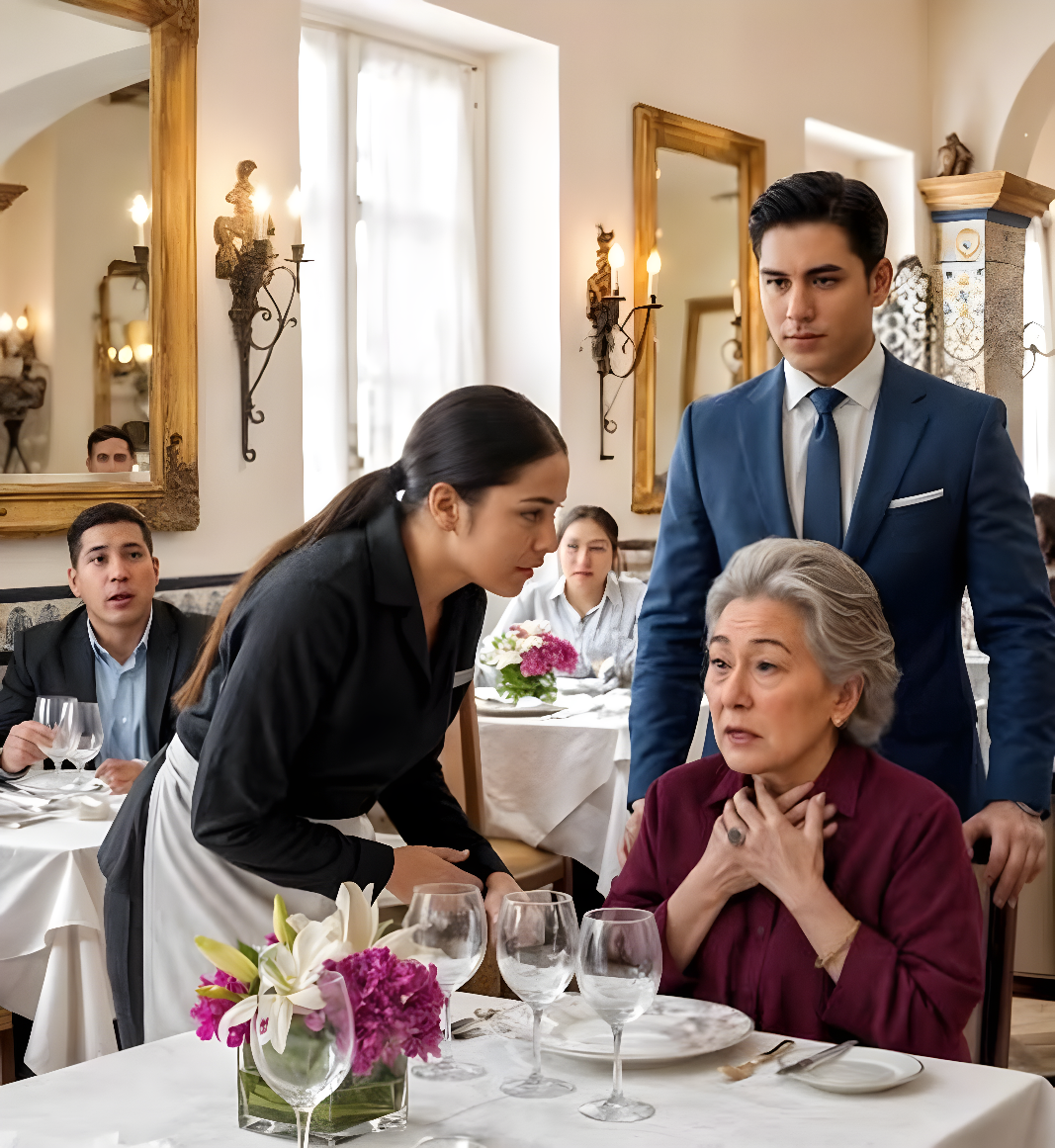
The Le Ciel Five Stars dining room seemed like a scene out of a cinematic masterpiece.
Crystal chandeliers illuminated the space with a warm glow, a piano softly played in the corner, and crystal glasses chimed. Attire was tailored to perfection, luxurious watches adorned wrists, and evening gowns sparkled brilliantly. Every gesture, laugh, and glance was meticulously crafted to convey: ‘I have wealth, I wield power, I belong here.’
Yet, nestled at a table in a corner was a person who appeared entirely at ease yet completely out of place.
An elderly Japanese woman, roughly seventy years old, graced the scene. She wore no ostentatious jewelry nor an identifiable designer dress, but rather a simple, dark garment reminiscent of a kimono, accentuated by a subtle belt. Her silver hair was styled with meticulous care, and around her neck hung a small locket, which her fingers clutched repeatedly.
“I hear she’s one of the wealthiest entrepreneurs in Tokyo,” whispered a man to his companion, pretending not to observe her.
“I’ve heard she’s here in New York to finalize a multi-million dollar investment,” replied the woman in a hushed tone. “And she’s alone. No translators, no bodyguards…”
Initially, people gazed at her like a foreign queen; curious, admiring, with a hint of unhealthy fascination. But when the main server approached her with the menu, the mood shifted.
“Good evening, madam, may I…?”
She accepted the menu with trembling hands. As her eyes scanned the English text, anxiety mounted. She attempted to articulate her order.
“Uh… su… su-pu… supu? R… raisu?” she stammered, her accent thick.
The server blinked in confusion. Offering a polite smile, he reverted to English, speaking slower as if it could solve the dilemma. He pointed at items on the menu and raised his voice slightly.
“This one? Fish. Very good. And this… meat. Beef. You want? Yes? No?”
Her hands quivered even more. Gently shaking her head, it was clear she comprehended only fragments. At an adjacent table, someone let out a snicker.
“With all that money, she can’t even bother to learn English,” remarked a woman as she adjusted her necklace. “What irony.”
Another man added, almost gleefully: “So much power, and she can’t even order her dinner.”
The staff began to feel the tension. They replaced the server, first with the second, then with the third, attempting grand gestures, showcasing images on a tablet, repeating phrases again and again.
Nothing worked.
The millionaire withdrew more into herself. Her spine, once upright, seemed to bow under an invisible burden. Lowering her gaze, she clutched her locket as if it were her only means of support.
In this lavish room, her solitude was deafening.
Across the dining area, nearly hidden between columns, a young woman gathered empty glasses and filled water pitchers, trying to remain unnoticed.
Her name tag simply read: Emily.
She wasn’t part of the star team serving important clients but was assigned the back tables, noisy groups and tasks no one favored. Her ponytail was slightly disheveled, her hands reddened from dishwashing soap, and she hurried between tables, embodying the mix of haste and dread known by those who understand a mistake could cost them their job.
But her eyes noticed everything.
And for several minutes, she observed the elderly Japanese lady struggling with the simple act of ordering food.
Every time the woman attempted to speak and her voice faltered, Emily felt her heart constrict a little more. This wasn’t mere abstract compassion; there was something hauntingly familiar about this scene.
Her grandmother.
She recalled her sitting in the small kitchen of her childhood, in a neighborhood far removed from Manhattan, speaking to her in Japanese and urging her to repeat complicated sounds. Her grandmother had lived in the U.S. for over fifty years without ever truly mastering English. As a child, Emily had become the family’s official translator whenever a doctor, teacher, or official gazed at her in annoyance.
“I don’t understand what she’s saying,” they would exclaim, irritated.
And there she was, at just ten, striving to build a bridge the adults lacked the patience to construct themselves.
For years, Japanese had remained her best-kept secret. Her classmates barely knew she had Asian roots. In college at a public university, she studied linguistics, yet almost no one at the restaurant was aware of this. To her superiors, Emily was simply “that quick girl who never complains.”
Until that fateful evening.
She watched the manager grimace, frustrated, whispering something to the head server:
“If she can’t place an order, just bring her the fixed menu. Or let her go. We have people waiting.”
Emily felt something surge within her.
Stealing another glance at the woman—alone, hunched over, holding her locket tightly, gaze lost on an incomprehensible menu—she thought, That could be my obaa-chan. It could be her sitting here, unacknowledged.
Heart overpowered fear.
She placed the tray at the service station, wiped her hands on her apron, and before the manager could stop her, crossed the room towards the back table.
Each step echoed in her ears amidst the tense silence that had formed around the woman.
When she reached the lady, Emily did something she had never done in that restaurant: she bowed slightly in a small gesture of respect and looked directly into her eyes.
“日本語でお手伝いします,” she murmured softly.
The transformation was instantaneous.
The elderly lady’s eyes widened, as if someone had turned on a light behind them. The spoon she was holding nearly slipped from her fingers. For a brief moment, she appeared frozen. Then, her lips began to quiver.
Emily smiled, feeling a warmth rise from her chest to her throat.
“少しなら手伝えますよ,” she replied gently.
(Yes. Just a bit. But I can help you.)
All around them, the silence grew even heavier. Customers, who just moments ago had been whispering, now stared wide-eyed at this invisible waitress communicating in a language no one comprehended, yet bringing life back to the woman in the corner.
The elderly lady covered her mouth with her hand. A few tears escaped, unbidden.
Words began to tumble forth. Initially rapid, muddled by emotion; then clearer and more fluid. Emily listened with total focus.
The millionaire requested neither fine wines nor extravagant dishes. She was trying to communicate something far simpler: that she just wanted something warm, light, something reminiscent of home, because that day marked the tenth anniversary of her husband’s passing, and she was in New York to visit the spot where they launched their first business together.
“ご主人の命日なんですね…” Emily repeated respectfully. “Je suis vraiment désolée.”
(I’m really sorry.)
The woman nodded, wiping her tears.
Emily conveyed the precise requests to the chef: a light broth, white rice, fish prepared with minimal sauce. There were protests, remarks about the fixed menu, about “the restaurant’s image.”
However, the manager, who had made his way halfway across the dining room intending to reprimand her, froze upon witnessing the millionaire grip Emily’s hand firmly and bow slightly, her eyes gleaming with gratitude.
He had nothing to say. With a sharp gesture, he simply pointed towards the kitchen.
“Let them prepare what she’s asked for,” he muttered. “And make it perfect.”
For the remainder of the evening, Emily lingered near the table.
While she didn’t neglect other guests, she returned repeatedly, like an invisible thread maintaining this little island of calm amidst the opulence. She explained each dish in Japanese, translated every question for the kitchen, ensured the tea didn’t cool down, and made sure the restaurant treated the woman with the dignity she deserved rather than as an embarrassing spectacle.
The woman introduced herself as Keiko Saito. She shared her upbringing in a small neighborhood in Tokyo, far from the skyscrapers and the elegant tailors she wore today. She had toiled tirelessly and was underestimated countless times for being a woman, for being “too old,” “too traditional,” “too different.”
And despite it all, she was there. One of the most influential women in her field.
“でも…” she said, gazing into her tea cup. “お金があっても、言葉が通じないと… 本当に一人ぼっちですね。”
(But… even with money, if our words don’t reach anyone… we are truly alone.)
Emily felt a knot tighten in her throat.
She thought of her grandmother, of all those times she had seen her fall silent because no one understood her. The nervous laughter of adults, the impatient “Come on, someone translate” comments.
“Here… you’re not alone,” she said in Japanese, slowly so each syllable carried the weight of her feelings. “As long as I’m here, no.”
The millionaire smiled. Not that stiff smile one gives for photographs; a genuine, tender smile that crinkled her eyes and softened her brow.
At the end of the night, when Keiko’s driver entered the restaurant to escort her home, she stood carefully, took Emily’s hand, and squeezed with remarkable strength for a woman of her age.
She whispered something only Emily could understand:
“あなたのおかげで、今日は夫に顔向けできます。ありがとう。”
(Thanks to you, today I can face my husband, wherever he may be. Thank you.)
Emily felt her eyes well up with tears.
The others didn’t grasp her words but witnessed the deep bow, the brief embrace, the way the millionaire exited the restaurant with her head held high… so different from the hunched-over woman who, an hour earlier, couldn’t even order a bowl of soup.
As the door closed behind her, a murmur filled the room.
Some customers were visibly moved; others felt mere shame for the little laughs they had previously stifled. The manager, his face serious, summoned Emily aside. She swallowed hard, ready to face a reprimand.
“That wasn’t your section,” he declared, arms crossed.
Emily lowered her gaze.
“I know, sir. I just wanted to…”
“But had you not gone over, we would have come off as fools in front of one of the most important clients we’ve ever had. Do it again if you have to.”
He didn’t smile, but the tone was different. For the first time, he truly saw her.
The story could’ve ended there: an act of kindness, a saved evening, a comforted old lady.
But it didn’t.
Three weeks later, while Emily folded napkins before the evening shift, the receptionist approached her with an envelope in hand.
“This is for you. It arrived by courier this morning.”
The envelope was thick, made from quality paper. In one corner was the name of a Japanese cultural foundation based in New York. Inside were two items: a handwritten letter in Japanese and an official document.
Emily read the letter first.
Keiko expressed her gratitude once again for that night. But this time she spoke of more than just dinner. She recounted how Emily’s kindness reminded her of her own story: that of a young girl, decades earlier, who also worked as a waitress while studying, who felt invisible, who spoke a language no one seemed to care about.
She had discreetly investigated to learn more about Emily. She discovered her linguistics studies, her insufficient scholarships, and the long nights working to pay rent and books.
“I don’t want your talent to be confined between these walls,” the letter said. “The world needs more bridges like the one you built that day.”
The enclosed document was a full scholarship to complete her studies, as well as a year-long exchange program in Tokyo, with a position as an interpreter at the same cultural foundation that Keiko directed.
Emily dropped the paper onto the table and placed a hand over her mouth.
She had never allowed herself to dream so big. Studying, yes. Translating, maybe. But traveling to her grandmother’s homeland, becoming a professional interpreter, living out what had always been a hidden part of her?
Tears streamed down her face.
Not the weary tears from double shifts, but clear tears of surprise and relief. The tears of someone feeling acknowledged by life for once, hearing the message: “What you’ve done matters.”
Years later, Emily would traverse stages as a recognized interpreter, translating conferences, negotiations, cultural meetings between Japan and the United States. Her name would appear in official programs, on badges, contracts.
But even while seated in glass translation booths surrounded by modern equipment, she would never forget the echo of the piano in that restaurant, the twinkle of crystal chandeliers, and the broken voice of an old woman trying to make an order as simple as a hot meal.
She would remember that trembling hand clutching a locket.
She would recall the first Japanese word she dared to utter aloud at her workplace.
She would remember Keiko bowing her head in gratitude and thanking her in a way no language could ever truly translate.
And whenever someone asked her why she chose this profession, Emily would smile and reply:
“Because one day, I understood that a single word, in the right language, can restore dignity to someone. And there is no greater wealth than that.”
If this story has touched your heart, take a moment to reflect:
- Has a small act of kindness ever broken a barrier in your life, or in someone else’s?
Perhaps you don’t know it yet, but that moment could also change a fate.