Voices from the Kitchen
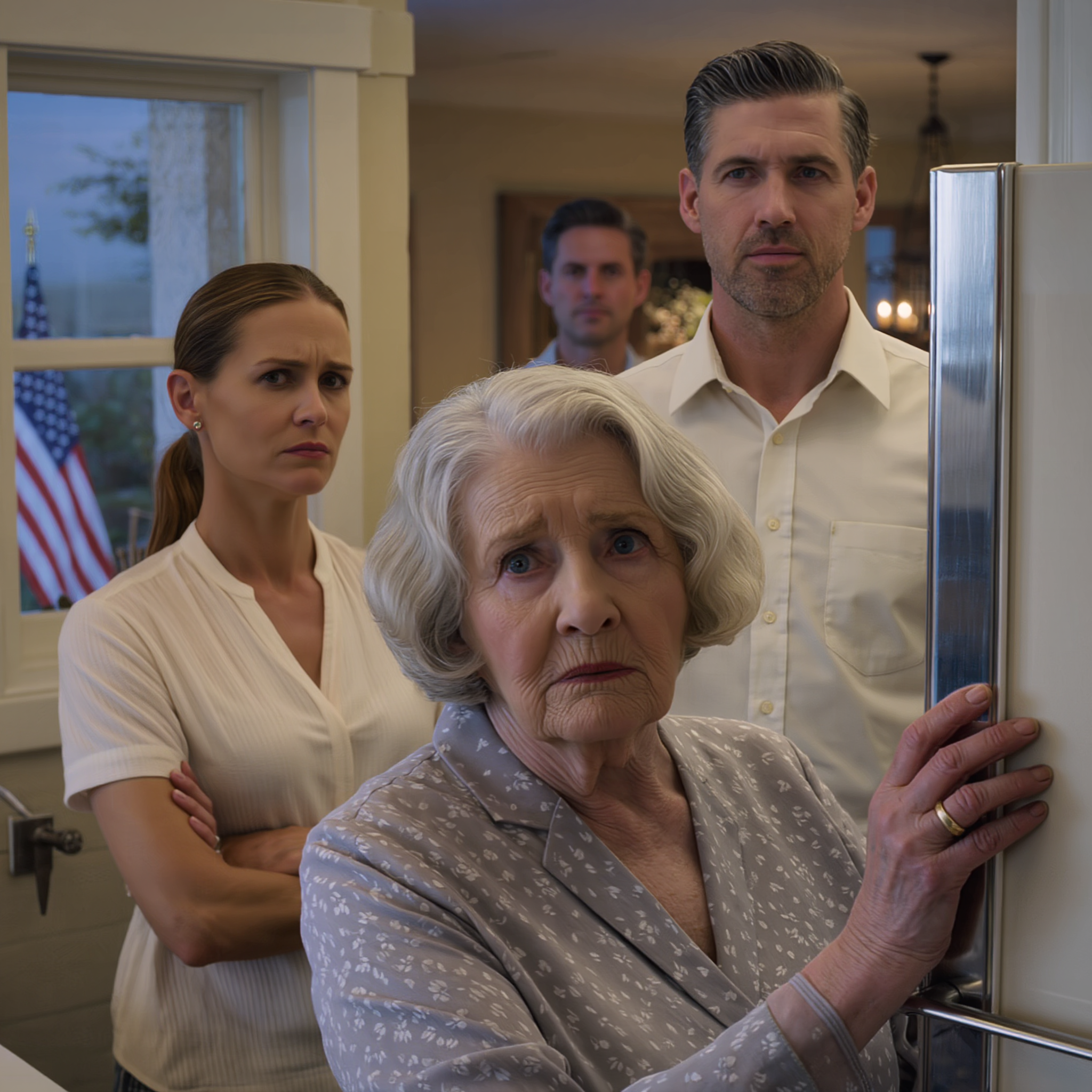
My daughter’s voice echoed from the kitchen entrance. My son-in-law quickly chimed in, “If my wife has already planned this, then we should adhere to her wishes.” At that moment, I felt a sudden paralysis. This house belonged to me; the food inside it was mine, everything was mine. I forced a smile and nodded in response. That evening, when she opened the freezer, she emitted a piercing scream and dashed around the room. It was an action I’d never imagined I would witness in my lifetime.
The brisk air from the stainless-steel fridge brushed against my face as I turned to see my daughter, Caroline, in the kitchen doorway, clad in her work blouse and fitted pants.
Her arms were folded, her gaze intense, and her mouth was drawn into a line I did not recognize.
Earlier that very day, I had stocked that refrigerator, spending nearly $200 at King Soopers down Parker Road. I had hefted the bulky bags into the kitchen, enduring the effort at sixty-nine years old, with knees that creaked up the stairs and a back that ached every morning.
But I kept those thoughts to myself.
I merely watched her with anticipation, hoping she would explain, that she might tell me it was all a light-hearted joke, that she would embrace me just like when she was a little girl.
But she remained silent.
“If my wife insists, that’s the way it is.”
This voice emerged from the corridor. It was Julian, my son-in-law, the man my daughter had chosen as her partner in life. Tall and impeccably dressed, he bore that smile that never quite reached his eyes.
He approached and placed a possessive hand on Caroline’s shoulder, as if staking a claim.
I stood there clutching the cheese.
“Mom, you heard me,” Caroline stated firmly. “I need you to refrain from touching anything in the refrigerator. Anything at all. My in-laws will arrive in two hours, and I can’t simply serve them anything. This is of great importance to me.”
Her husband’s parents. They were more significant than I was. More vital than the woman who had nurtured her, the one who had stayed by her side through every fever, the one who sacrificed her jewelry for her education.
“I understand, sweetheart.”
That was all I managed to say because something broke inside me at that moment.
It wasn’t a loud crack. There was no shouting or chaos. It was quiet, like the snapping of a dry branch—almost imperceptible, yet entirely final.
I gently returned the cheese to its spot in the refrigerator and closed the door slowly. I dried my hands on my apron, all the while maintaining a smile.
I smiled because, in that moment, I realized something profound.
I understood that my daughter no longer viewed me as her mother. She saw me as an obstruction, as someone who impeded her, someone to be cast aside.
And I smiled because I resolved that if they planned to treat me this way, then I, too, would make my own choices.
“I’m heading to my room. Enjoy your dinner.”
I turned toward the staircase, feeling their gaze pierce into my back. But I refused to look back. I ascended each step with my spine straight and my head held high.
Yet inside, I trembled.
Once I reached my room, I shut the door firmly. I sat on the edge of the bed—the very bed where I had shared dreams with my husband, Arthur, for thirty years. Where I had wept when he passed away ten years prior. Where I had been left in solitude until Caroline persuaded me to move in with her.
“This is your home too, Mom. You’ll always have a place with us.”
She had assured me two years earlier when I sold my little house on the outskirts of town to assist with the down payment for this one. When I invested all that I had earned into this property, which was supposedly meant for both of us, a family space for togetherness.
Lies. It was all lies.
I stood and peered out the window. From there, I could glimpse the backyard, the roses I had planted on my own, the small lemon tree I had tended since moving in, and the herb pots I nurtured each morning. I accomplished all of it with my own hands, through my own efforts.
Downstairs, laughter erupted; music played, the doorbell chimed—the in-laws had arrived. I could hear Caroline welcoming them with a sweet tone she reserved for others but not for me. I overheard Julian offering beverages. I could hear dishes clattering and glasses clinking.
And I remained upstairs in my room, much like a child in trouble, as though I had committed some offense. Yet my only wrongdoing was providing the very food they now relished.
I positioned myself in my chair near the window, the same chair I had brought from my old house, the single piece of furniture Caroline allowed me to keep. Everything else had either been sold or given away because, according to her reasoning, this house had a unique aesthetic that did not accommodate my older possessions.
I fished my cellphone from my pocket, scrutinizing it for a moment. The temptation to call my sister Ruth back in New Mexico crossed my mind, to share what transpired, but what could I say? That my own daughter had restricted my right to eat in my home?
It would sound absurd. It would appear as though I was exaggerating, like an attention-seeking dramatic old woman.
I returned my phone to my pocket and merely sat there, gazing out the window as the day faded into night.
Hours slipped away. I caught the sound of the in-laws departing. Then I heard when Caroline and Julian ascended to their room. Finally, the home grew silent.
I tiptoed downstairs, careful not to make a sound.
The house was enveloped in darkness, save for a small light shining over the stove. I ventured into the kitchen, greeted by a pile of dirty dishes in the sink, glasses stained with remnants of wine, and leftovers on the table—my food, the dishes I had purchased, which I had not even nibbled on.
I opened the refrigerator, searching for something to consume, but it was nearly bare. They had devoured almost everything. Only a few leftovers nestled in plastic containers remained.
I retrieved a container, finding cold rice within. I consumed it standing by the opened refrigerator, illuminated by its light, casting a glow on my weary face.
And as the cold leftover rice vanished down my throat, I comprehended something further.
I realized this was not a sudden occurrence. This had been a gradual process, so subtle that it escaped my notice. Like the frog in a pot of water that heats incrementally, failing to escape the boiling point until it is too late.
The small slights, the biting comments, the disdainful glares—all part of a scheme to confine me, to make me feel burdensome, to foster a sense of gratitude for merely having a shelter overhead.
But that shelter belonged to me as well.
I had placed $50,000 down as a contribution toward the mortgage. Every penny I had saved from years of sacrifices made with my husband. I had given it to Caroline because I held trust in her, because she was my daughter. Because I believed she would care for me as I had cared for her.
I shut the refrigerator door, washed the empty container, and positioned it away. I cleared all evidence of my presence, as if I were a ghost. As if I had no right to exist in my home.
I retreated back to my room and lay down. Yet sleep eluded me.
Thoughts coursed through my mind, recollections merging, revealing a bigger picture.
The previous six months had felt peculiar. Caroline consistently asked me to sign documents that purportedly originated from the bank. Refinancing papers, tedious formalities that I did not entirely grasp. Each time, I signed with trust because she was my daughter.
But now I began to question what I had signed. What were those records? Why was Caroline always in such a rush? Why could I never scrutinize them thoroughly?
Before dawn, I rose silently. I stepped out of my room, moving diligently. Downstairs, I inspected the desk where Caroline stored essential documents, but it was locked.
I sought the key in obvious spots but found nothing.
So, I retrieved my box of personal papers from my room, searching for the original deed to the house, the proof that I had put my money into this home that was also mine.
It was absent.
The deed was not in its usual place. I rifled through every paper in every folder. Nothing. It had vanished.
And at that moment, clarity struck.
I grasped the truth entirely.
I had been robbed.
Not just of my dignity, not simply of my peace, but of my finances, my security, my future.
I seated myself on the floor of my room, surrounded by papers scattered like confetti. And I did not weep. I did not shout. I refrained from causing a scene because I understood that crying would restore me nothing. That screaming would paint me as a senile woman craving attention. That no one would believe me if I started hurling accusations sans evidence.
So I resolved to act with intelligence. I would investigate. I would retrieve what was rightfully mine, but discreetly, without alerting them to my awareness of their treachery.
All the papers went back into place. I washed my face, combed my hair, and dressed like I would on an ordinary day.
When Caroline emerged for breakfast, I was already in the kitchen, brewing coffee.
“Good morning, Mom.”
“Good morning, sweetheart. Did you sleep well?”
“Yes, very well. Thank you.”
She beamed at me, a flawless smile as though nothing had transpired, as though the prior night’s humiliation had not occurred, as if she had not been the one to rob me of my peace.
And I smiled back because I had learned how to play her game—the game of silence, the game of patience, the game of waiting for the precise moment to act.
I served her coffee. I prepared her favorite meal. I inquired about her plans for the day, presenting myself as the ideal mother—the obedient, submissive woman she desired me to be.
But internally, I had already begun planning.
I was calculating every step, every move, contemplating how I would reclaim my life, my home, my dignity,
Because if I have learned anything in my sixty-nine years, it’s that revenge is a dish best served cold—very cold—and I had ample time to devise my strategy.
There are moments in life when one questions at which precise moment everything begins to shift. At what instant does the individual you cherished transform into someone unrecognizable.
I pondered that question numerous times in the days that followed, and I consistently arrived at the same conclusion.
Everything had commenced long before I was ready to accept it.
Caroline arrived in my life when I was twenty-six years old. The pregnancy had its hurdles—I was on bed rest during the final four months. Arthur, my husband, worked dual shifts at the factory on the outskirts of town to compensate for my absence from work.
We were young, filled with dreams and ambitions. When she entered the world, everything seemed to align.
She was a beautiful infant, her large, dark eyes sparkling with life—a smile that illuminated any space.
I nurtured her, treating her as if she were made of glass. I provided nourishment, bathed her, and crooned lullabies my mother had instilled in me long ago in our former Kansas home. Arthur adored her. He returned home weary from work yet always found energy to engage with her, to elicit laughter.
I can vividly recall the day she took her first steps. I was in the kitchen, preparing dinner, when she clung to the couch’s edge and pushed herself forward, wobbling precariously before collapsing onto her bottom—yet she had achieved it, and I cried with profound joy.
I phoned Arthur, who clocked out early just to witness her once more.
We experienced happiness. Our finances were tight, residing in a modest two-bedroom apartment. The furnishings were old, the carpet worn, yet it was home, and that sufficed.
Once Caroline turned five, she commenced kindergarten at the local primary school a few blocks away. I managed to secure a part-time job at a bakery on Main Street to assist with expenses. Arthur continued at the factory. We worked hard, saved diligently, and envisioned one day purchasing a home, of providing Caroline with everything we had missed out on.
She excelled academically. She consistently brought home good grades, shone in school plays, and formed friendships. She was the epitome of a normal, blissful child.
Or so I believed.
Looking back now, I identify instances I previously overlooked. Tiny details I ignored because I wished to avoid acknowledging problems where I misperceived none.
Such as when she was eight and I requested her to share her toys with the neighbor’s daughter. She vehemently refused, hoarding her belongings in her room, locking the door tight.
Assuming it was merely a phase that all children endure, I addressed her, elaborating on the value of sharing. She nodded but never parted with her treasures.
Or the time she was twelve and uncovered $100 I had hidden away for emergencies. She sought approval to purchase a dress she had spotted at the mall. I said no. That money had a purpose.
She exploded in anger. For three days, she did not speak to me. When she finally resumed communication, it was as though nothing had transpired. Yet I discovered the money missing, and she never mentioned it again.
I should have recognized the signs earlier. I should have noticed the warning signs. But I was so consumed by work, so fatigued by the end of each day, so focused on survival that I overlooked the cues.
When Caroline was nineteen, tragedy struck—Arthur suffered a massive heart attack at work, collapsing right in the middle of his shift. By the time he reached the hospital, it was tragically too late.
When I received the call at three in the afternoon, my life split into two halves—before and after. Before Arthur and bereavement.
Caroline did not cry at his funeral. This surprised me. She maintained a serious demeanor, somber and quiet, eyes devoid of tears. I reached out, asking if she was okay.
She assured me she was merely processing everything and would cry later.
But I never caught a glimpse of her shedding tears for her father.
The ensuing years proved to be arduous. Arthur’s life insurance was modest, enough solely to cover funeral expenses and leave a slight cushion. I persisted with my work at the bakery while additionally cleaning houses on weekends.
I needed funds to support Caroline’s college ambitions; she aspired to obtain a business degree at a state university. It was an exorbitant major, but I was prepared to labor tirelessly for it.
I sold Arthur’s tools, his old truck, and even some jewelry I’d stashed away—all for her tuition, textbooks, and basic necessities.
I learned to compromise on meals and wore the same clothes year after year, refraining from any unnecessary purchases. Everything was for her. Everything.
During college, visits from Caroline were strictly financial. She would reach out, announcing unexpected expenses, needing funds for projects, asking for special fees, and I complied without hesitation, without second-guessing, because she was my daughter, because I thought I was investing in her future.
When she graduated with honors, I felt immense pride at the ceremony, tears streaming down my cheeks. All the sacrifices had been worthwhile.
Or so I believed.
She immediately secured a job at a prestigious company in downtown Denver, earning a hefty salary. She excitedly informed me that now she was taking over my care, asserting it was her turn to support me, that everything I had done for her would be reciprocated multifold.
And I wanted to trust her—that she would suddenly value me, that she was inviting me into her life.
The months passed, but nothing changed.
She continued to ask for funds—for certification courses, for work trips, for professional attire. And I kept providing, as it was my nature. I had always been the giver, the one who sacrificed my happiness for others, the one who prioritized everyone else over myself.
Then came Julian, whom she met at work. She introduced him to me six months after their relationship began. He appeared kind and courteous, impeccably dressed. With a wealthy background, he worked at the same firm as Caroline. I was genuinely happy for her, believing she had found someone to bring her joy.
They tied the knot the following year in a grand wedding at an elegant ballroom near the city center, attended by over two hundred guests. I contributed $15,000 from my savings towards the occasion.
Caroline insisted it was the least I could do since the groom’s family was covering much more. She could not afford to appear subpar.
And so, I complied.
That $15,000 amounted to years of hard work and self-denial.
At the wedding, Caroline barely acknowledged my presence. Her focus was dedicated to her in-laws, the crucial guests—she exchanged mere words with me, presenting me as her mother before swiftly moving on, treating our interaction like a necessity she needed to fulfill.
The early months of marriage found them residing in a modest apartment near the light rail line. I visited them on Sundays, bringing food and helping with cleaning in any capacity. Yet, I consistently felt like an inconvenience, a disruption they wished would not happen.
Then came discussions surrounding purchasing a home.
Julian desired something larger, in a superior neighborhood with excellent schools “for future children,” he proclaimed.
However, they lacked sufficient funds for a down payment, needing $50,000.
Then, they turned to me.
“Mom, you have savings, right?” Caroline asked. “Could you lend us the funds for the house? We’ll repay you gradually, with interest if you wish. Besides, you could live with us. You wouldn’t have to feel lonely anymore. It would be perfect—a family once more.”
Those were Caroline’s enticing words.
I wanted to believe her. I longed to believe she was authentically including me in her life, giving me a place in her home, that she finally appreciated my worth.
I sold my house, the small one that Arthur and I had purchased after years of saving, the house where we raised Caroline, where we experienced happiness.
I sold it and handed her every penny—the complete $50,000.
She promised to include my name on the deed, assuring me the house would belong to both of us, that I would have my own room, my own sanctuary, that I would always be welcomed.
I signed every document they put before me because I trusted her; she was my daughter.
But now, I recognize that to be the moment of my undoing—the precise point at which I relinquished control over my life, where I became an unwelcome guest in what was meant to be my home.
Initially, the months I spent in the new home felt tolerable.
Caroline maintained a facade, greeting me each morning, incorporating me into certain conversations, allowing me to assist in cooking and household choices.
Yet a peculiar tension lingered, something elusive I couldn’t quite articulate. An invisible burden that clung to the air each time I entered a room.
Julian worked late, often secluding himself in his study upon returning.
Caroline seemed absorbed in her phone for prolonged periods.
I remained absorbed in cleaning, cooking, and tending to the garden—trying to be productive, striving to justify my presence in this home that too was mine, albeit feeling increasingly unwelcome.
One day, whilst cleaning the dining room, I stumbled upon miscellaneous bank documents on the table. Their presence was unplanned, the result of my cleaning, never intending to invade privacy. But my name appeared on one of the pages, captivating my interest.
It mentioned the mortgage on the house. I read it hurriedly, struggling to understand. Numbers, legal jargon that bewildered me, and yet one thing emerged clearly.
My name was absent from the deed as an owner. Instead, it appeared only as a reference. As someone who had contributed, but not recognized as an owner.
A chill raced through my body.
Trembling, I grasped the paper again. I reread everything slowly, endeavoring to locate my name among the owners, only to find nothing.
Only “Caroline Herrera and Julian Reyes.”
Nothing more.
I heard footsteps approaching. Instinctively, I returned the document to its former position and resumed my cleaning.
Caroline entered the living room, her accusatory gaze scrutinizing me with that expression she had adopted—a combination of irritation and superiority.
<p“What are you doing, Mom?”
<p“Merely tidying up, darling. Just tidying.”
I remained standing, gripping the cleaning cloth with a racing heart, countless questions racing through my head.
That night, slumber eluded me. Each thought surged, fueling a cascade of realizations.
Perhaps I had misjudged. Maybe my name was featured on alternate documents—the original deed, perhaps. Caroline had assured me she would list me. It was her promise, that the house would belong to both of us. Surely, she wouldn’t deceive me.
But the seed of doubt began to sprout and rapidly proliferate, tainting every reverie.
In the days that followed, I grew increasingly perceptive, honing in on things I had once overlooked. For instance, the times when Caroline required me to sign paperwork without allowing me to read it completely. She nonchalantly claimed they were mere banking formalities, dull matters unworthy of my review.
Given my trust, I signed each time.
One afternoon, while Caroline was preoccupied with work, I went looking in the living room desk. I needed to find the deed to the house. I needed to verify my ownership, to ensure everything remained uncontested and I was not merely paranoid.
But the desk was locked.
I sought the key in apparent locations: the kitchen drawer, atop the bookshelf, the entry shelf.
Nothing.
I attempted to pick the lock, employing a paperclip and bobby pin, but to no avail. The desk remained closed, obscuring its secrets from me.
Then, I recalled that I held my own set of documents.
When I sold my house, I preserved everything within a specially designated box—important records, my marriage certificate with Arthur, his death certificate, payment receipts, and—theoretically—the deed for this house, the proof of my financial contribution.
I ascended to my room, retrieving the box from underneath my bed. Eagerly, I opened it, hands shaking with anticipation. Burrowing through papers, I scrutinized every document, inspecting each folder, every envelope.
The deed was conspicuously absent.
The document hadn’t returned to its intended place.
Instead lay a receipt, confirming my $50,000 transfer to Caroline’s account, yet nothing else. No document demonstrating my ownership of the house.
I collapsed onto the floor, surrounded by all that I had, struggling to recollect the last place I had seen that deed. Where had I put it? Who else possessed access to my room?
I realized Caroline had a key. I had entrusted her with it, believing it would facilitate her cleaning when I was absent, or when her bathroom was occupied. I never fathomed she would use it to shamefully steal from me.
But now, all became clear.
She had invaded my privacy. She had invaded my personal space. She had discreetly rolled through my possessions, taking the very document that protected me, unearthing it or concealing it in some manner.
I returned every paper to the box, carefully closing it. I secreted it in a different location, burying it at the back of my closet behind old boxes, ensuring it remained undetected.
That evening, Caroline returned from work late. She carried a shopping bag from an upscale store at the mall—fashionable clothes and shoes, items that totaled hundreds of dollars.
I watched her unpack, remove tags, and try things on while exuding carefreeness.
And I considered my own $50,000. Recognizing that amount signified more than just money—it encapsulated long hours of labor, years of sacrifice, each early rise, every sleepless night, each attempt at frugality.
All for the pursuit of security, to have something of my own that no one could strip from me.
Yet that very money now funded her lavish wardrobe, her opulent lifestyle, their large house, while I clung to nothing—merely a room they could easily evict me from, only a seat at a table where I increasingly felt alienated.
I descended to the kitchen, preparing tea to soothe my nerves and reclaim my clarity.
With water boiling, I readied my favorite mug, the one from my old house, a simple white ceramic cup decorated with hand-painted flowers— a cherished gift from Arthur on our first anniversary.
As I waited for the water to boil, Julian strolled into the kitchen.
He regarded me with the same disdain he’d wielded recently—as though I were simply an obstruction, an inconvenience.
“Eleanor, we need to chat.”
I turned to him, maintaining my poise while inquiring what he wanted to say.
“Caroline and I have been contemplating. This house is becoming notably costly to maintain. Utilities, property taxes—everything continually increases. Meanwhile, you reside here without contributing anything. You consume our food, utilize our electricity and water—all of it comes from our pockets.”
His words splashed over me like icy water.
Me, who had just filled the refrigerator with $200. Me, who cleaned every inch of the house, who cooked, who worked in the garden, striving tirelessly to avoid being seen as an inconvenience.
But I refrained from speaking, waiting for him to conclude.
“Thus, we believe it’s only fair you contribute financially—a nominal amount of $500 in monthly rent. Of course, that’s the bare minimum; any room in this neighborhood demands double the amount.”
$500 to exist in a place to which I had helped contribute. A home where I had invested my money, the same house that was supposedly a shared space.
“Of course, Julian, I’ll consider your proposal.”
“There’s little to ponder, Eleanor. It begins next month. Caroline will furnish you with the particulars.”
He poured himself a glass of water, sipping slowly while watching me, almost as if he anticipated my response or possible resistance.
But I remained still, clutching my empty mug.
Once he exited, I switched off the stove, lacking any appetite for tea or anything else. I longed to retreat to my room, lock the door, and digest all that had transpired.
Each step toward my room appeared burdensome. Once inside, I gently closed the door and sat down upon my bed.
And for the first time in a rather long while, I permitted myself to weep.
Quiet sobs escaped me, face in my hands, body trembling, as I wept for my naivety, my foolishness, trusting so readily without protecting myself. It was a sorrow for having delivered everything without preserving my interests; for believing a mother’s love was sufficient.
Eventually, those tears dried up.
In their place, something else emerged.
A coldness. A tenacity. An inner strength I had not recognized before.
Angoose.
But not the furious wrath that incites screams. No, a calculated rage that devises plans—waiting for precision to execute.
I stood, rinsed my face anew, gazing at myself in the mirror.
I beheld a sixty-nine-year-old woman—tired, lined, sixties gray hair—but with eyes wide open, brimming with resolve.
I was determined not to remain passive. I would refuse to allow them to rob me any longer. I would not permit them to treat me like trash.
I had given too much. I had sacrificed far too much.
And now it was time to reclaim what was once mine.
The ensuing days felt surreal.
I continued my routines. I awoke early, prepared breakfast, cleaned the house, tended the garden.
But there was a shift within me.
I was no longer driven by affection. Every action bore a methodical intent. Each word was careful, calculated. Each smile, a facade.
Caroline remained oblivious. Or perhaps she simply did not care. She engaged with her life, her job, and her outings, treating me like an inanimate piece of furniture—something that existed yet deserved no attention.
Even then, I allowed her to maintain that perception since it suited my plan. I sought to lower their defenses. I began observing everything astutely—their schedules, routines, departures, arrivals, where crucial items were kept, and whispers exchanged when they thought I was not listening.
One morning, as I tidied the living room, I stumbled across Caroline’s forgotten phone on the couch. She must have overlooked it during her frenzied exit to work.
I stared at it for a while.
I knew her password. I had observed her enter it numerous times—four straightforward digits formed by their wedding date.
I picked up the phone, my hands slightly shaking, my mind crystal clear.
I accessed her messages, scouring her conversations with Julian, her friends, her in-laws. I read swiftly, mentally cataloging each detail.
A conversation with her friend Samantha caught my eye. The texts were recent. Heart racing, I quickly read through them.
“I’m almost finished getting my mom off the deed. The lawyer assured me the process will be solidified within two weeks. At last, I can sell this house and purchase something superior without her being able to stake a claim.”
The words hit me like a physical blow.
I read the message again and again as the information lodged itself in my mind.
She hadn’t just sought my removal from the deed; she intended to sell the house—the very home I aided in procuring, to secure something for herself devoid of my rights.
I continued down the conversation’s track and uncovered more conversations revealing weeks’ worth of coordinated schemes.
“My mom is such a gullible lady. She signs whatever I put in front of her. No questions asked. All it takes is one final document, and it will be finished. Problem solved.”
“Problem.”
I was regarded as a problem by my own daughter, a person whose life I had sacrificed everything for—reduced to a situation requiring resolution.
I snapped photos of every text with my phone. My hands trembled; some came out blurred, but I captured numerous images of each one. I needed this evidence—proof of deceit.
There was another message with someone named “Maxwell Price,” a man I did not recognize.
I opened their exchange.
“Mrs. Reyes, as mentioned last week, we have processed the documents you submitted previously. Your mother has signed the waiver of rights to the property. Everything appears in order. We just require her signature on one last document, and the procedure will be concluded. You’re welcome to drop by the office at your convenience.”
A lawyer.
She had consulted a lawyer. Fabricated documentation. She had coerced me into signing away my rights, without me ever comprehending the consequence.
I recorded the lawyer’s name, his contact number, and his office’s address as noted in the chat. Every detail counted.
I persisted with my surveillance. I documented the scanned papers, images of documents I had unwittingly signed, contracts, waivers, rights statements—everything laid bare, trophies of betrayal.
I captured images meticulously, ensuring they were clear, articulating every word legibly.
This represented a goldmine.
This was critical evidence substantiating their deception.
I heeded the sound of a vehicle in the driveway. Panic surged. I peered out the window. It was the neighbor. I needed to hurry; Caroline could return at any moment.
I located a folder titled “Mom Docs.” Opening it, I discovered copies of my identification, my birth certificate, the deed to my old house, and the receipts for her money transfer. The information they required to take advantage of me was organized there, just like a criminal case file.
Then I spotted something else.
A recent paper. A listing for a new house in a different neighborhood, a bigger one, dated last week.
They were already scouting for a new residence while conspiring to remove me.
I snapped images of everything before urgently clearing Caroline’s recent applications, ensuring she would not suspect interference. I returned the phone precisely to its original position, preserving the angle and placement.
Back in my room, I firmly closed the door, sunk onto my bed, and connected my phone to my old laptop—the one I brought from my previous home. I transferred each photograph, saving them within a hidden folder. I replicated every file onto a backup USB drive stored away safely.
I could not risk losing this evidence.
As I executed the transfer, I visualized every piece of information I had uncovered. My own daughter had calculatedly orchestrated my downfall with that cold efficiency, as if I were merely an obstruction to her aspirations, something to be eliminated so she could flourish.
I completed the transfer and concealed the USB drive behind a box of tampons in my bathroom cabinet. No one would ever think to investigate there, particularly not Julian.
Later that evening, I ventured to the kitchen, boiling water to make tea, a calming ritual I had come to value, easing my nerves and honing my focus.
When the water reached a rolling boil, I reached for my cherished mug, reminiscing about the warmth it once brought me, a simple cup that Arthur gifted me years prior.
My concentration broke as Julian walked into the kitchen.
He glanced at me with the same disdain he had been brandishing recently—as if I were merely an obstruction to be tolerated.
“Eleanor, we need to speak.”
Turning toward him, I remained calm, eager to hear what he had to voice.
“Caroline and I have been considering the costs associated with this home. Utilities, property taxes, everything is escalating. Quite frankly, you’ve been living here while contributing nothing. You eat our food; you utilize our electricity, our water—all from our budget.”
His statements struck like frigid water pouring down my back.
Me, who had just loaded the refrigerator with $200. Me, who had scrubbed the house, prepared meals, and cared for the yard, striving to ease my presence.
But I chose not to respond; I opted instead to wait for him to continue.
“Thus, we believe it’s fair for you to pay something—$500 a month, an incredibly minimal fee that pales in comparison to what any room commands within our neighborhood.”
To dwell in the space I assisted in obtaining. In the house I aided to finance. In a domicile that was supposedly also mine.
“Of course, Julian, I’ll think on it.”
“There’s little to contemplate, Eleanor. Payment begins next month. Caroline will provide the specifics.”
Pouring himself a glass of water, he sipped slowly, studying me as if he expected me to rebel or show defiance.
However, I maintained silence, harboring my empty mug.
Upon his exit, I shut off the stove—no longer craving tea or anything else. Retreating to my room seemed the only solution, to lock myself in and process the slew of events.
Ascending the stairs, each step felt heavier than the last. Inside my room, I secured the door and sank onto my bed.
This time, when the tears flowed, they did so in silence.
Hot tears streamed down my cheeks, a manifestation of grief for my foolishness, for my gullibility in placing trust where it should never have been bestowed. A lament for having compromised so much, for having believed in the unbreakable bond of motherhood—especially the lies wrapped in false assurances and promises.
But eventually, those tears subsided.
They were replaced by something entirely new.
A steely resolve, one I never knew resided in me.
An icy rage.
Yet not the fiery rage that incites anger. It was a purposeful anger that calculated its moves, that bided its time for the perfect moment to act.
I returned downstairs once more, washed my face, cautiously brushed down my hair when Julian unexpectedly entered the kitchen again.
He scrutinized me, reading my expression with some semblance of concern.
“Eleanor, I’m concerned for your well-being.”
His words hung between us, charged with emotion.
I felt uneasy and implored him to speak further.
“I just worry about what this is doing to you, your health, your wellbeing. I think you need to let this go.”
But deep inside, my determination firmed.
I entertained the thought of keeping silent, of letting the past wash away, of merely enduring the status quo.
No. I could never acknowledge that.
It was their intention, to placate me into allowing it to fade into obscurity. But I had nothing left to cater to their needs.
Instead, I withdrew into solitude for the next few weeks as they navigated their lives. I silently began preparing my next moves, working methodically to gather everything I needed, culminating in a crescendo of resistance.
The season passed into fall. The air turned crisp, signaling the approach of winter, while everything outside my life transitioned into a somber silence.
My life became a meticulous construct—a web woven together with the threads of reality, fragments of turbulent years manifesting in reflections. I engaged in tasks that kept me moving, acting with relentless purpose.
Until the day arrived.
The day of reckoning.
Heedless of the time the courtroom would consume, I donned dignified clothing, stepping into the judgment arena with historic fortitude.
Inside, my heart raced with adrenaline. I felt like a warrior walking into the battlefield, ready to retrieve my dignity and self-worth. Each day had been building toward this moment, every sacrifice like an arrow drawn taut, waiting for release.
The shots were fired in quick succession, exchanging barbs of wit and tongue like deft dueling swordsmen within the confines of the law.
In the end, regardless of the outcome, I had proven something vital: I possessed the strength to fight back. I had risen to the challenge and would emerge victorious, not just against them, but against the shadows that had threatened to engulf me.
The final verdict rang through the court, reverberating like the toll of a bell—my fate unraveling like fragile twine. In that fleeting moment of silence, the ties would sever, my identity would manifest anew.
But I was not finished yet.
This was my fight, and it would continue until I reclaimed everything that belonged to me.
I had endured enough.
I broke free. Not merely from the chains that bound me but from the immeasurable weight of dishonor they had sought to cast upon my heart.
The profound peace settling over me was something I could finally call my own.
As the months progressed, I discovered myself blossoming into a new life—quiet, peaceful, and all of my own making.
The blooms were just beginning to sprout.
In every reflection, I saw the truth resound: I was more than a mother, a mere spectator in my life. I was a warrior, a survivor, and above all, a woman reclaiming her power.
Each dawn greeted me with an invitation to bask in my newfound freedom, and I gloried in it as I breathed in deeply, absorbing the vitality of the morning sun.
I was alive. I had endured. And now, I would thrive.
Because the truth no longer resided only in silence. It lived within me, fostered by the love I had learned to gift myself.
In closing: This journey of mine taught me that true strength is never in denying oneself—true strength is in reminding ourselves of who we are in the face of adversity.